


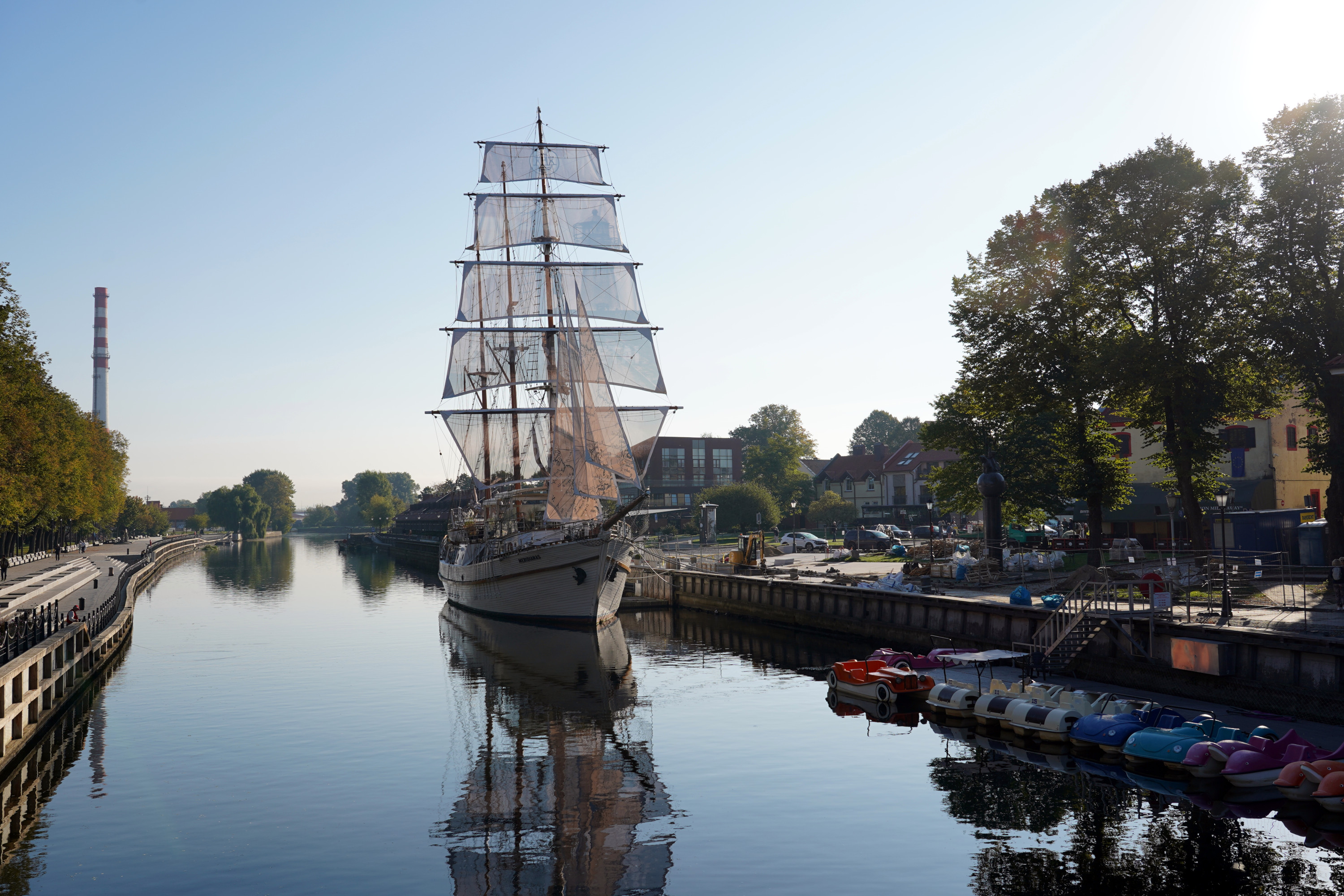
Welcome to our third leg: Lithuania. We enjoyed beautiful weather for the most part; the clouds returned only once—in Nida and again at the end in Vilnius—but the rain was short-lived.
Before reviewing the photos, I had the fewest clear memories of this third part of the trip: there was the Curonian Spit, Kaunas, and then Vilnius—but was there anything else? Perhaps this was partly because we were already somewhat exhausted after the experiences in Estonia and Latvia. Is visiting three countries in just over two weeks simply too much? It is certainly good to have plenty of photos, though, as they allow you to relive your vacation in a relaxed way once you are back home—and that is exactly what happened for me while putting this album together.
Overview
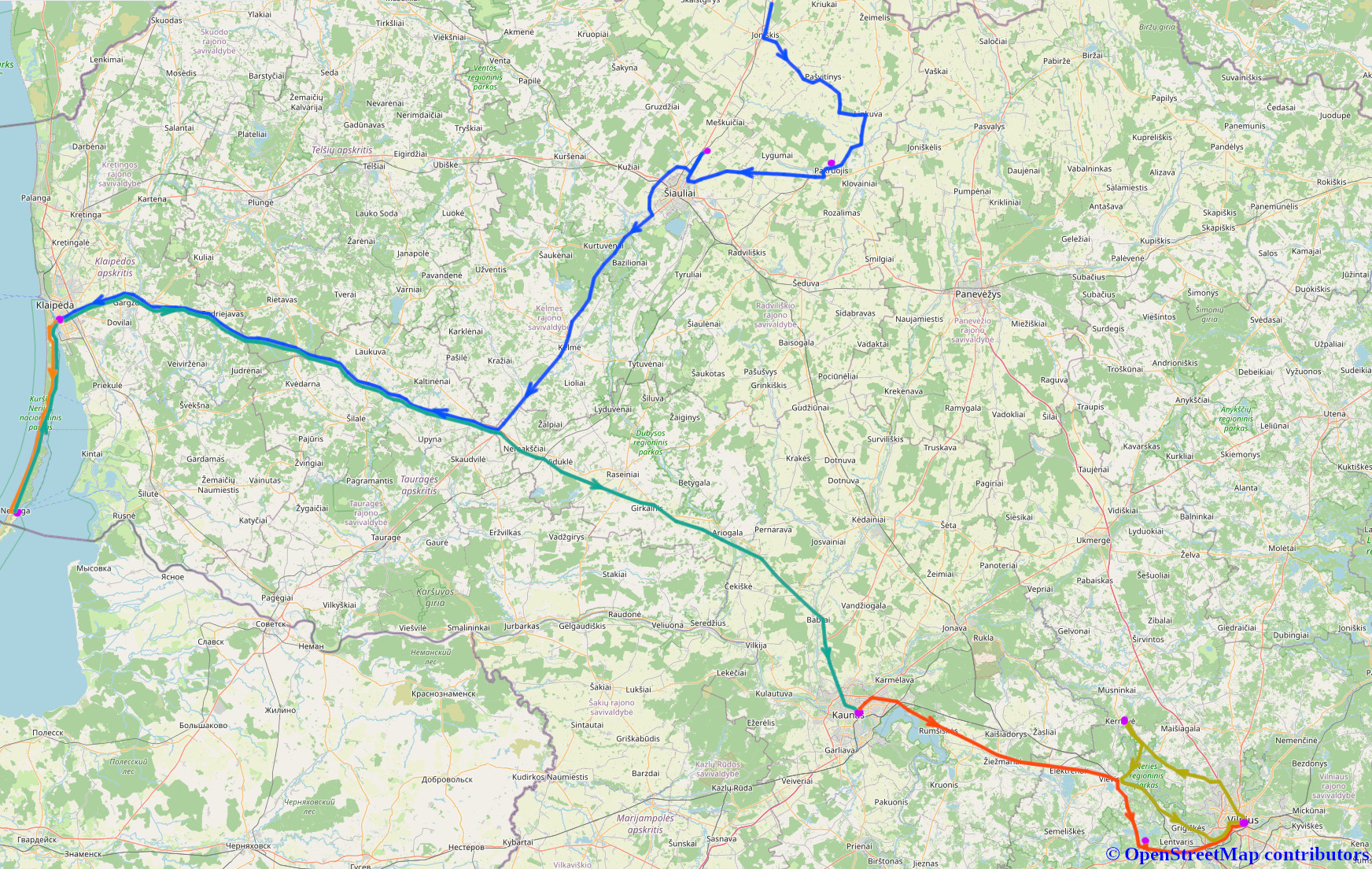
The journey begins at the top of the map, where we crossed the border from Latvia into Lithuania. It turned out to be quite a long day of travel, starting in Riga (see Latvia) and ending in Klaipėda.
First, we visited Pakruojis Manor, followed by a stop at the Hill of Crosses. We then drove for three long hours heading south and west until we reached Klaipėda (formerly Memel). After exploring Klaipėda, we traveled to the Curonian Spit and spent two days in Nida, located on the spit near the Russian border (Kaliningrad region).
Next, we continued to Kaunas and then to Trakai Island Castle. There, we partially prepared our own lunch: kibinai, traditional pastries made by the local Karaite minority. Afterward, we arrived in Vilnius and explored its Old Town on foot. To conclude the trip, we hiked through the Kernavė Cultural Reserve, a site showing traces of civilization dating back over 10,000 years.
Klaipėda
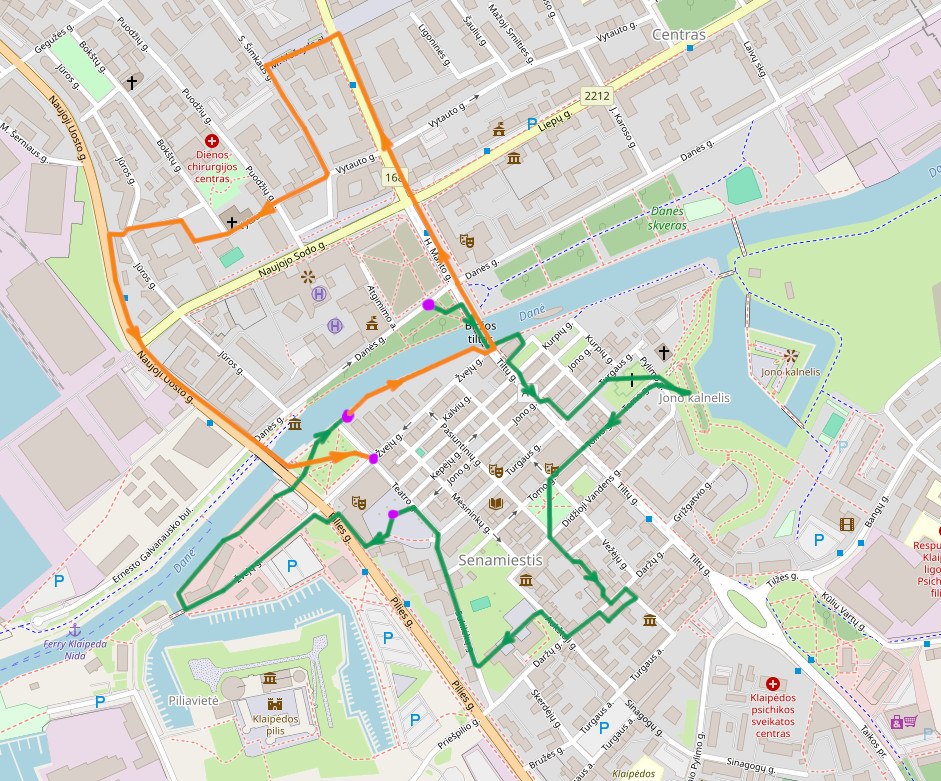
The port city of Klaipėda—formerly known by its German name, Memel—boasts a long history. Our tour (the green path) began at the Biržos Bridge, which emits an eerie rumbling sound whenever a heavy vehicle crosses it. We continued to the site of the former St. John's Church; nothing remained of the building after the war. After a walk through the Old Town, we encountered the "Ännchen von Tharau" statue and looked for a place to have lunch. That concluded the official program in Klaipėda, though I spent a little more time wandering the streets with a few fellow travelers, following the orange route.
The bus picked us up later and took us to Nida on the Curonian Spit.
Kaunas
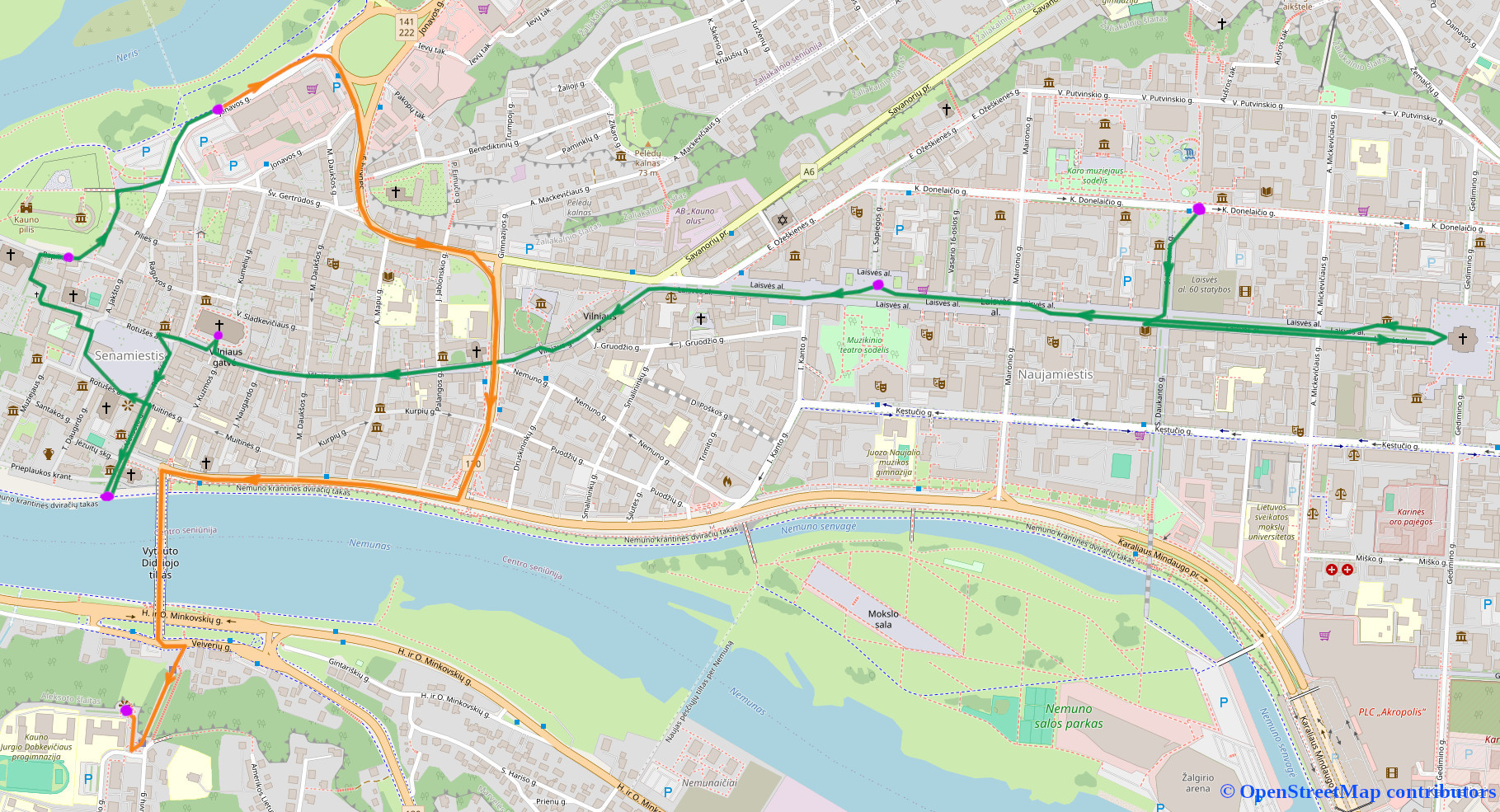
After the relaxing days on the sunny spit, we continued our sightseeing in Kaunas. The pronunciation is a bit surprising, as the 'a' sounds almost like an 'o'—making it sound something like [co-nas]. For the most part, our sightseeing route followed Freedom Avenue (Laisvės alėja). We visited the Cathedral of St. Peter and Paul, saw the Nemunas River, and took the funicular up to a viewpoint (the orange path).
In the evening, we took a public bus from our hotel (located off the map) into the city center, had dinner there (again on Freedom Avenue), and walked back to the hotel, passing the Garrison Church along the way.
Vilnius
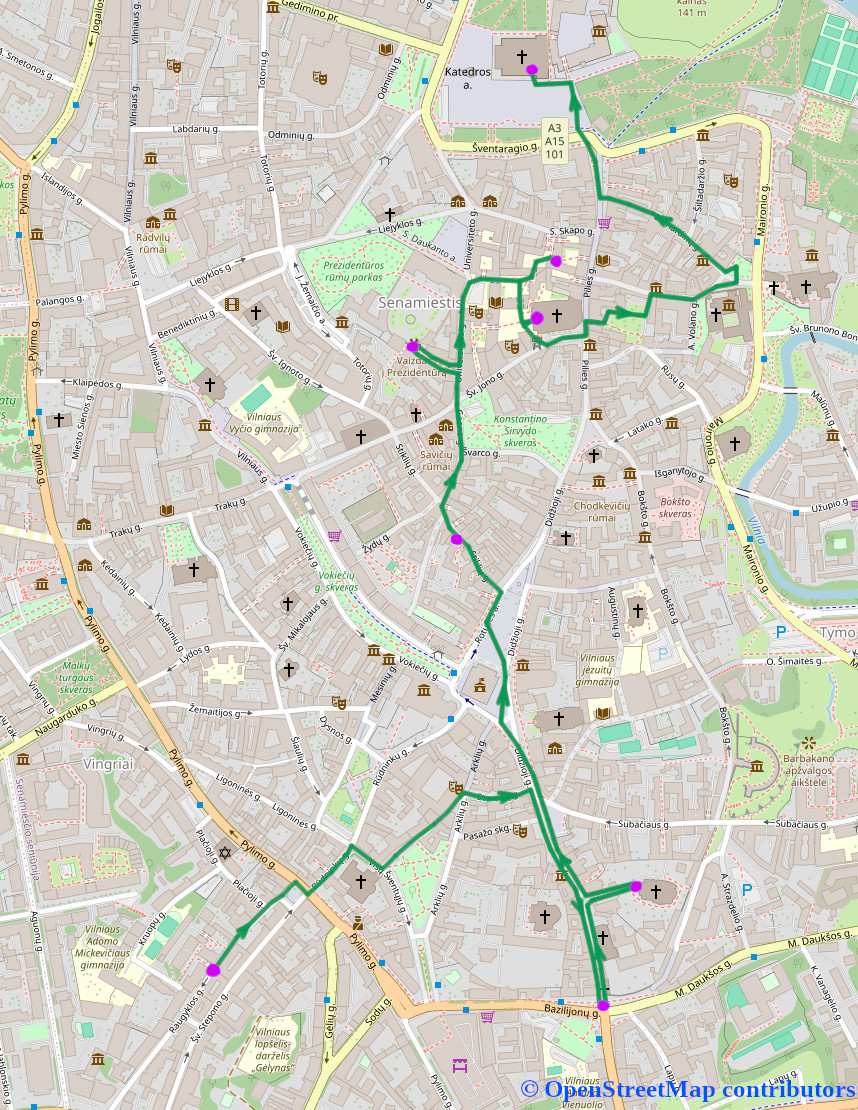
We embarked on our final city walking tour in Vilnius, the capital of Lithuania. After many sunny days, the weather took a turn for the worse, bringing a light drizzle, but it cleared up again by midday. We started at the Gate of Dawn, then walked past the Presidential Palace to the university, where we admired the modern fresco "The Seasons of the Year". Around noon, we visited the last church on our itinerary: Vilnius Cathedral.
In the afternoon, we headed out into the countryside, traveling northwest. At the Kernavė Cultural Reserve, we had a chance to stretch our legs—though I took a nasty spill while descending a wooden bridge (fortunately, I remained uninjured)—and later that evening, we dined at the restaurant Lokys, where I enjoyed an unusual dish: beaver stew.
Photo collection
Public images
Click on a photo to enlarge it. Members of my travel group may ask me for a passwort to unlock photos with visible group members.


Lithuanian language
As with the previous parts, let’s take a brief look at the language itself. If Estonian sounds like Finnish and Latvian a bit like Russian, then Lithuanian bears a superficial resemblance to Polish. From a linguistic perspective, Lithuanian is particularly interesting because, among the descendants of the Proto-Indo-European language, it retains the highest number of archaic features.
However, one shouldn't expect to understand it easily. Unfortunately, many words differ from their Latvian counterparts—for instance, the word for "street" is gatvė in Lithuanian. You really have to learn Latvian and Lithuanian separately; knowing one won't get you very far with the other.
The orthography is not quite as phonetic as Latvian's, though it is still manageable. Palatalization (the insertion of a "y" or "j" sound) is not explicitly marked in writing; any consonant other than "j" can appear in two forms—palatalized and non-palatalized (e.g., b and bj, d and dj, t and tj, and so on).
A distinctive feature of Lithuanian is the small hook (or *ogonek*) beneath certain vowels—a mark also found in Polish, though here it simply indicates vowel length. The letter sequence "ia" is pronounced like an "e"—something to keep in mind when encountering place names like *Šiauliai*, which is pronounced "sha-uley." The letter "y" represents a long "i" sound.
There are háček marks for the letters C, S, and Z:
- č = "ch" (as in *church*)
- š = "sh" (as in *shoe*)
- ž = voiced "sh" (as in *measure* or *journal*)
The final unusual mark is the dot above certain "e"s, as seen in the word "gatvė". This indicates a closed E sound, similar to the vowel in the German word "See" (rather than the open "e" in "hell").
Lithuanian also features tonal distinctions—variations in vowel intonation. The so-called rising accent is marked with a tilde and indicates that the sound is pronounced with constant volume throughout its entire duration. With a falling accent, the volume drops rapidly while the sound is being articulated. However, these tones are usually not indicated in writing.
And for comparison, here are the first five numbers again:
| Number | Lithuanian |
| 0 | nùlis |
| 1 | víenas |
| 2 | dù |
| 3 | trỹs |
| 4 | keturì |
In Lithuanian, Germany has an unusual name, Vokietija, which strongly resembles the Latvian version. The etymology assumes a Latvian origin, actually.
And now in Lithuanian: O dabar mėgaukitės mano nuotraukomis iš Lietuvos!
