


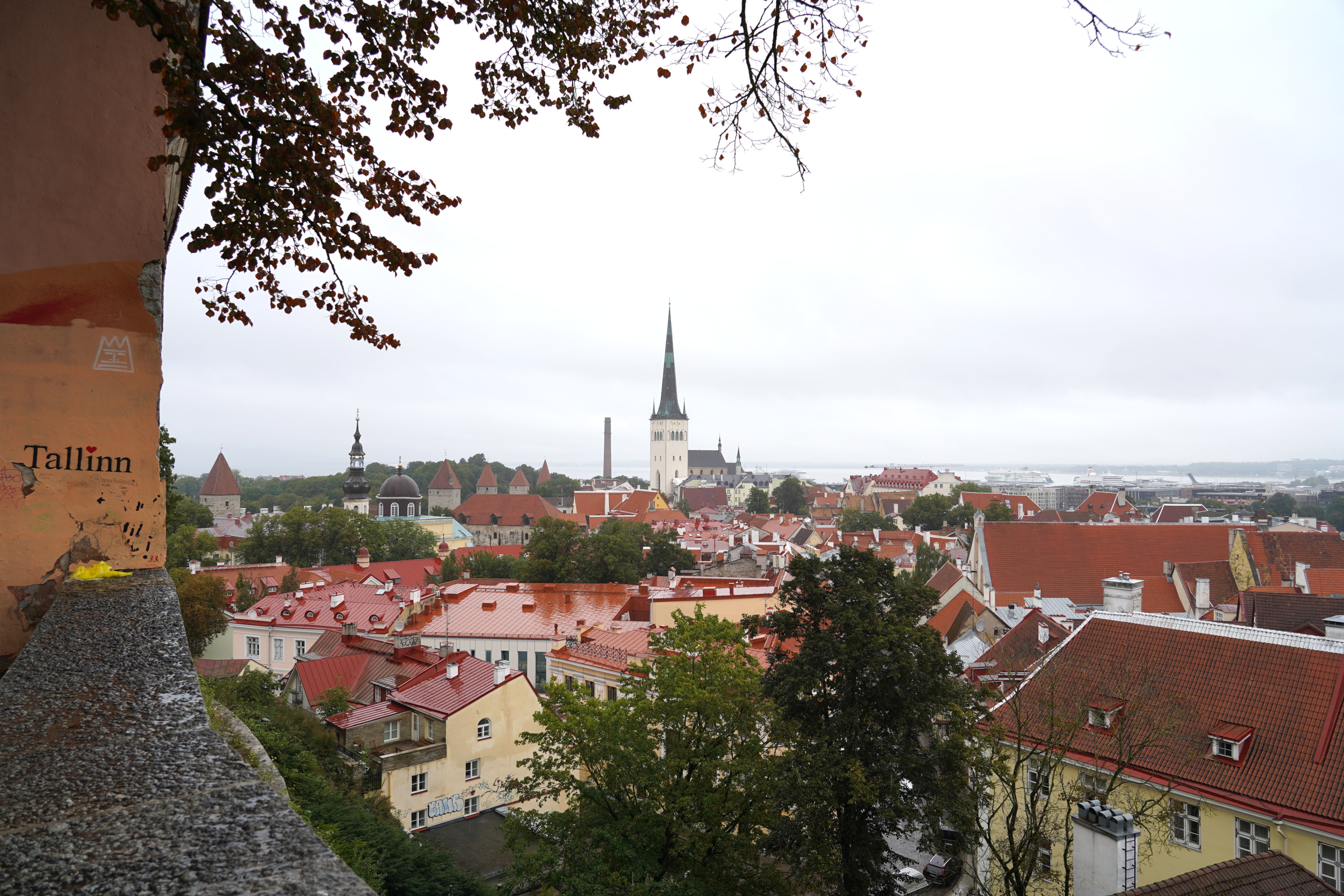
Our trip starts in Estonia. One of the reasons that the pictures took so long for publishing was, in fact, the weather. The weather was, well, not really inviting at the start, and then I actually lacked a bit of motivation to browse through hundreds of photographs with various shades of gray skies. So Tallinn, Estonia's capital, was covered by a thick cloud layer and weak light, also with rain on the first days, but it got much better from then on.
Estonia, and Tallinn in particular, have lots of interesting spots, though. Estonia was governed for a long time by the Teutonic Order since the middle ages. You can find many traces from these times, and as a German, I was surprised to find so many relics of German in the language itself (unlike Finnish, see my reports about the polar lights in Finnland), also in German names, German texts under statues and paintings, or in coats of arms.
Overview
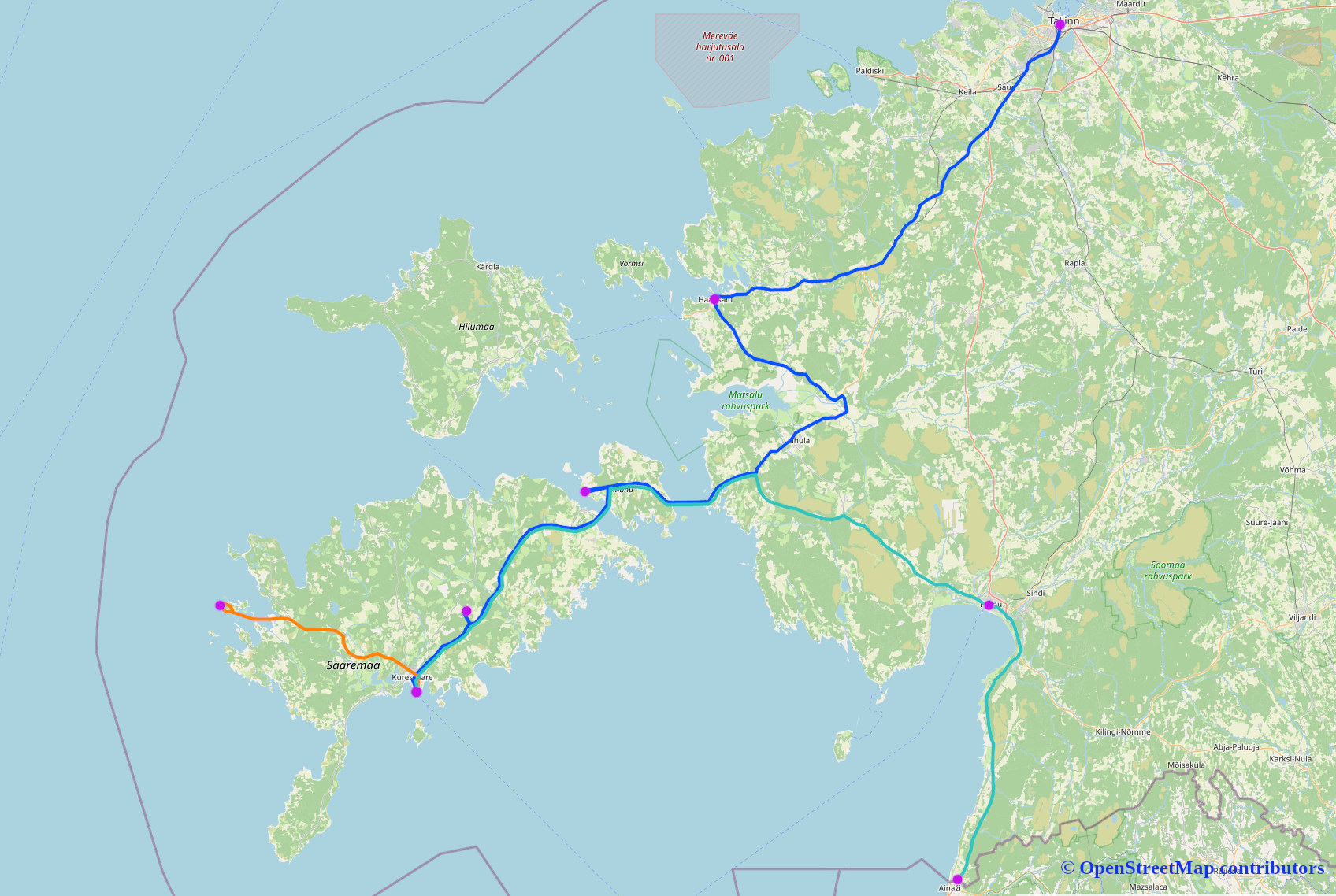
This map shows our journey across Estonia. It starts in Tallinn (at the top), takes us west first to the town of Haapsalu, then to the island of Muhu with the village museum, and then to Estonia's largest island, Saaremaa. From there we set off on a hike on the neighboring island of Vilsandi. From Saaremaa we went to Pärnu, the summer capital, over lunch, before we left Estonia south towards Latvia a short time later.
Sightseeing tours
Before I present the photos, I would like to introduce some of the tours that we took at various stops on the trip. This also makes the background of the photos clearer, which can be found below.
Tallinn
Before 1918 (and unofficially to this day), Tallinn was known as Reval; however, whether the name truly originated from a roe deer and its fall from Toompea Hill is likely impossibleto prove. Nevertheless, at the alleged site of the fall, there is a small park featuring a statue of a roe deer. The name Tallinn, however, is more easily explained: Taani refers to the Danes (as Estonians do not use the letter D), while Linn signifies a castle or fortress—yet another nod to the city's eventful history.
The architecture still exudes this medieval flair: narrow, steep lanes winding up to Toompea Hill, half-timbered structures, ancient churches, and the old city walls of Reval. Then, in contrast, there is modern Tallinn—specifically the Rotermann Quarter—which underwent a complete redevelopment at the turn of the millennium. Where dilapidated industrial buildings once stood, one now finds a large cinema, a host of pubs and shops, and a vibrant gathering place for people of all ages.
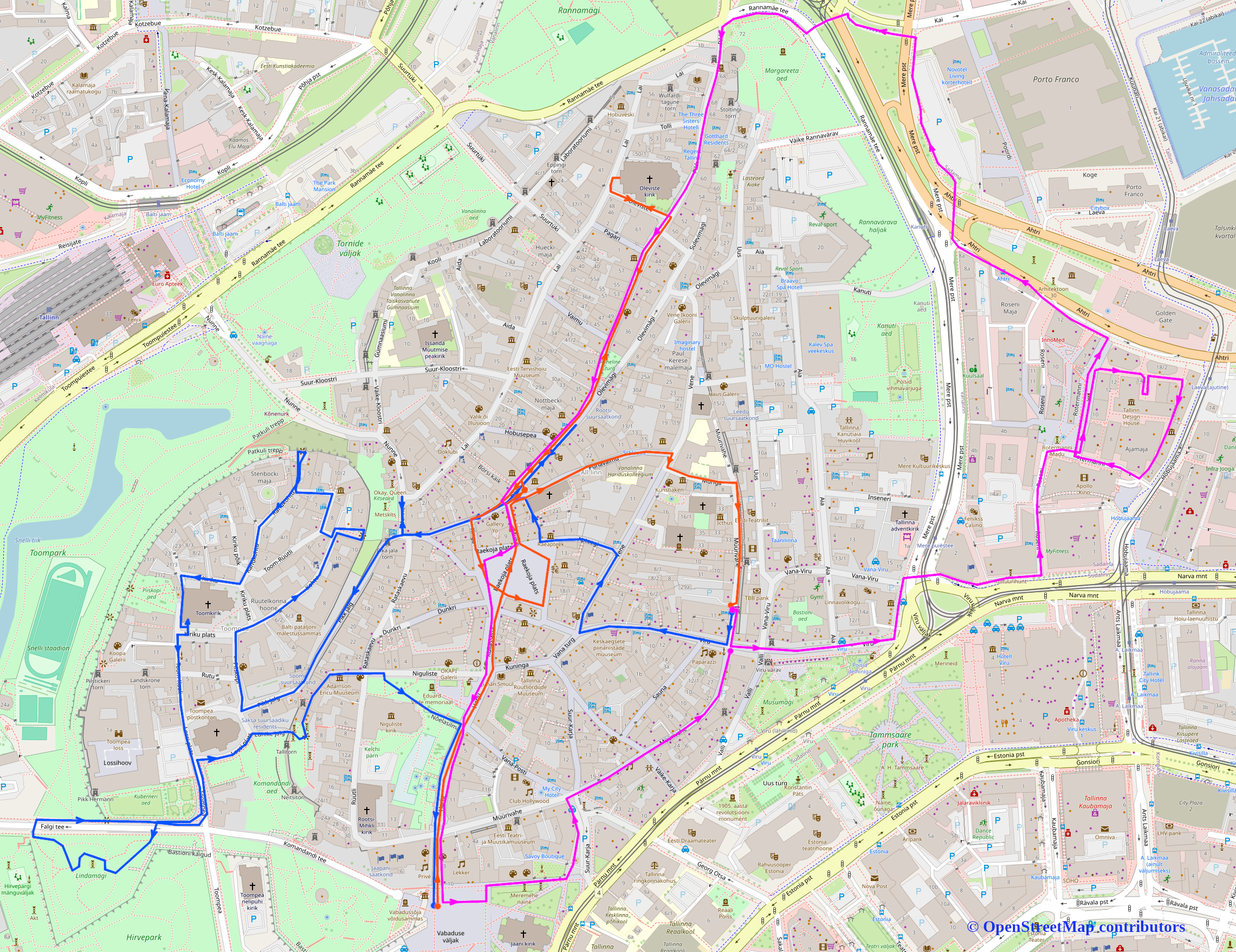
The first two days were dedicated to the capital; the map illustrates our walks through the Old Town (click to enlarge). The blue path marks our official morning sightseeing tour, during which we walked from our hotel—passing the Town Hall Square—up to Cathedral Hill (left) and concluded our tour at the Independence Monument (bottom). From there, we walked (red path) in smaller groups northward, crossing the Town Hall Square to reach the famous Café Maiasmokk, where high-quality marzipan is available for purchase. Afterward, we headed to St. Olaf’s Church—climbing to the top—before making our way back through the Old Town. I then climbed up onto the Tallinn city walls near our hotel. In the evening (magenta), we went out for dinner (not shown), then strolled through the Rotermann Quarter (right); subsequently—approaching from the north—we traversed the Old Town one last time by night before returning to our hotel.
Vilsandi
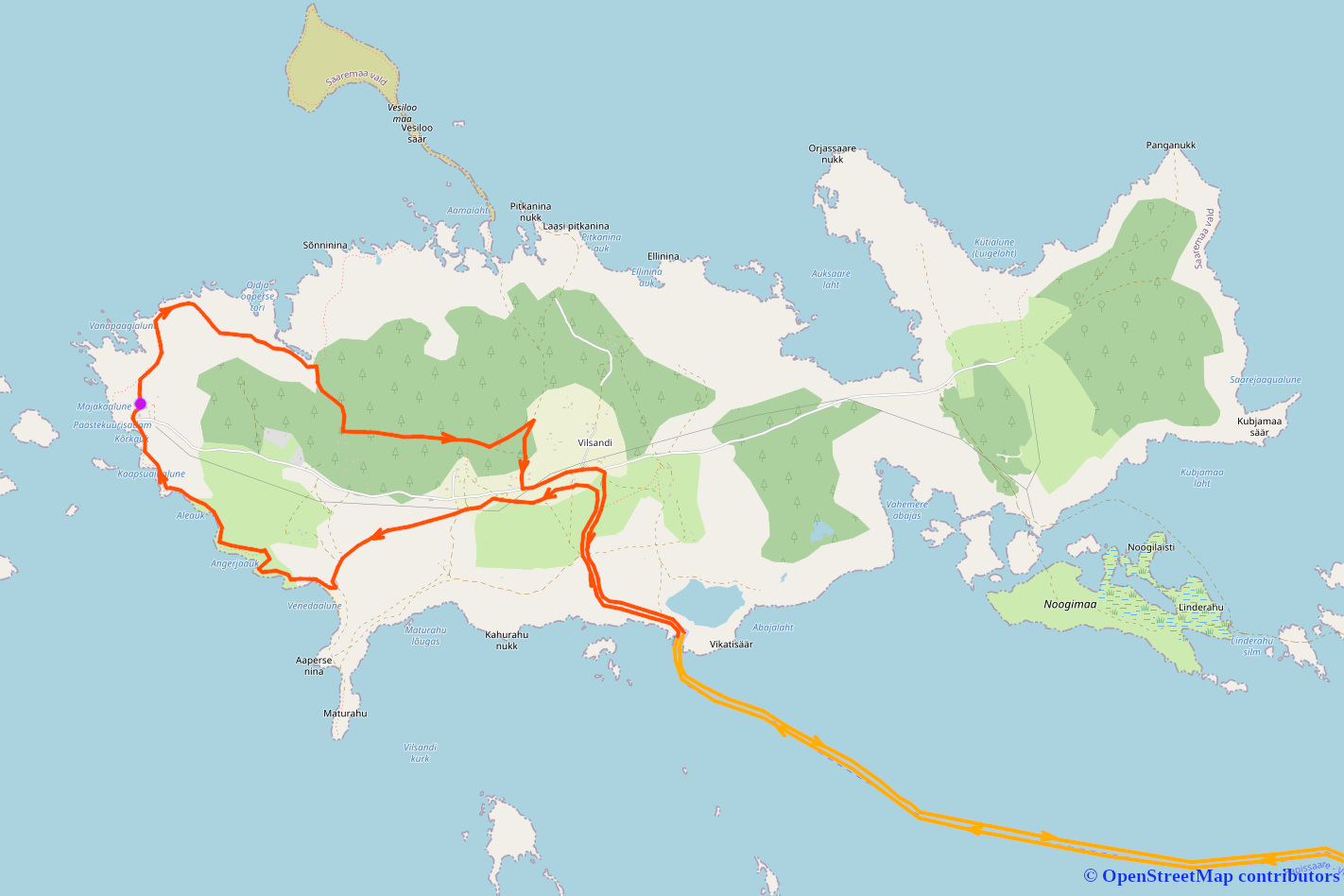
The island of Vilsandi is part of Vilsandi National Park, which comprises numerous smaller islands in addition to Vilsandi itself. Vilsandi is inhabited—albeit primarily by just a few researchers—but it has no actual settlements. Visitors are transported to Vilsandi by boat, which must maneuver its way through the cluster of small islands.
On Vilsandi, one can experience an abundance of unspoiled nature—if only the weather had been a little nicer (though, at least, it stayed dry)—while following long hiking trails that lead to a solitary lighthouse situated at the island's westernmost tip (built in 1809). Traversing a forest in the center of the island, we eventually made our way back to the harbor, where the boat took us back to Saaremaa.
Pärnu
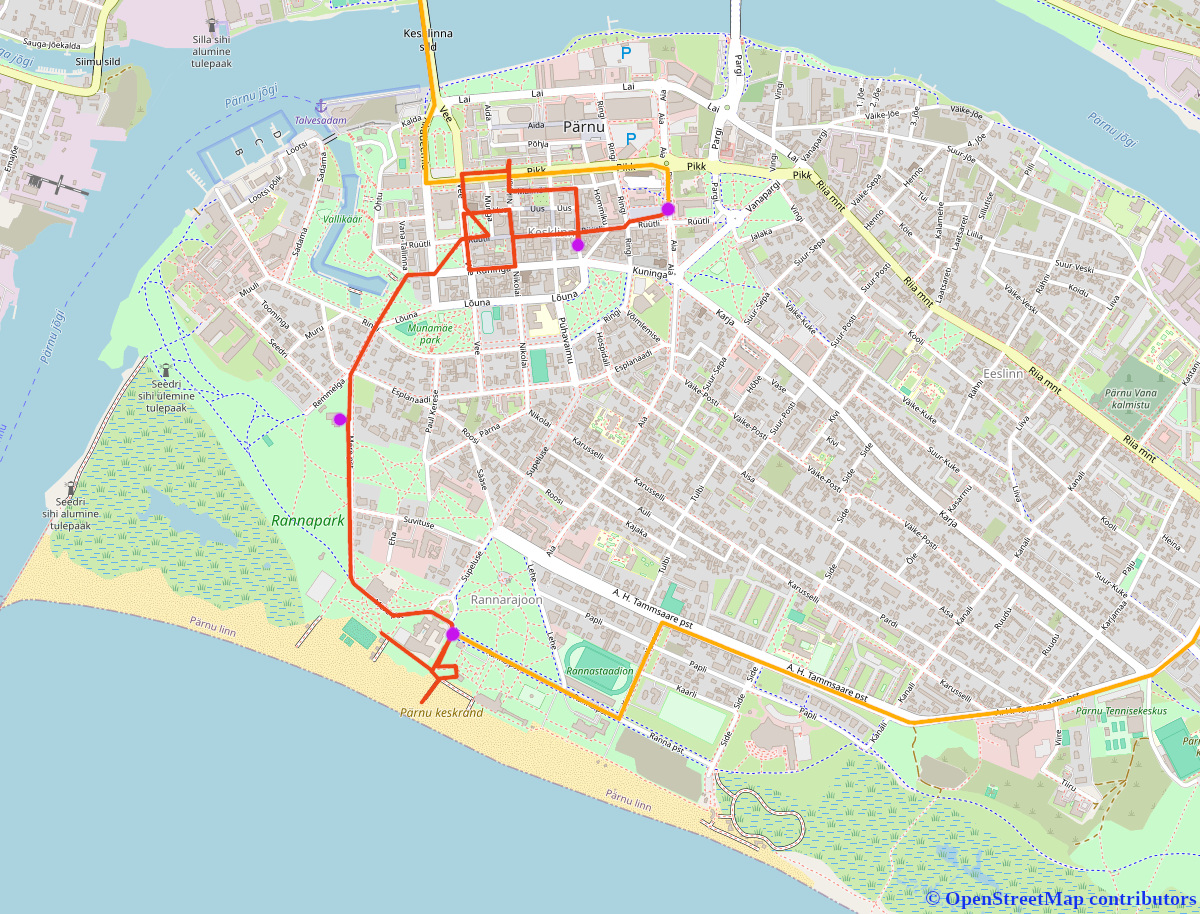
Right on cue, the weather demonstrated that it was capable of something other than that neverending, damp grayness just as we arrived in Estonia’s "summer capital", treating us to the long-missed sunshine.
Pärnu is, of course, considerably larger than the sightseeing tour map would suggest; the entire area across the river has been omitted from it. It has a population of around 50,000 and was founded in the mid-13th century by the Teutonic Order under the name Pernau. It is a renowned seaside resort—a status it maintained throughout the Soviet era, when it served as a popular spa town.
We explored the historic city center, found a nice spot for lunch, and strolled past the Art Nouveau Villa Ammende on our way to the beach—a genuine sandy beach, right here in the far north. Afterward, in the afternoon, we continued our journey southward by bus, eventually crossing the border into Latvia.
Photo collection
Public images
Click on a photo to enlarge it. Members of my travel group may ask me for a passwort to unlock photos with visible group members.


Estonian language
As with my other trips, I am always interested in the local languages, and Estonian is fascinating in several aspects.
Estonian is closely related to Finnish, as you can see with the first numbers already:
| Number | Finnish | Estonian |
| 0 | nolla | null |
| 1 | yksi | üks |
| 2 | kaksi | kaks |
| 3 | kolme | kolm |
| 4 | neljä | neli |
In fact, "null" is borrowed from German (which got it from Latin ultimately), whereas Finnish got it from Swedish.
Estonian features a rich case system with 14 cases (compare German with just 4 cases or English with 2). These cases replace the prepositional constructs in the Indo-European languages.
Where the German cases refer to the questions for
- wer (who), wessen (whose), wem (to/for who/whom), wen (who objective)
the Estonian cases ask
- who, whose, of what, into what, in what, out of what, to where, on what, from where, for what, up to what, as what, without what, and with what?
and modifies the word accordingly. For instance, toomkirik is the cathedral, and a sign on one photo showed the form toomkirikusse. This word as such translates as "into the cathedral".
This is in fact a challenging grammar for Into-European speakers, be it German, English, French, Norwegian, Greek, Italian, Czech and so on.
Luckily, Estonian is easy to read for us Germans. The writing is phonematic, that is, each letter represents a sound, and most of the letters are well-known in European languages. The only exception is
- Õ (O with tilde, that is, a wave above), for instance: õhk (air) oder even doubled: Urmas Sõõruma (the architect of the revovcated Rotermann quaters).
This letter somewhat sounds like a mix of o and ö in German, as if someone from Saxony with a broad accent says "Boot" or "Not". Roughly said, you have to pronounce "o" with retracted lips.
Also mind that double vowels indicate length (not like o vs. oo in English, which changes the sound), and double consonants also mean a long sound.
So all that is left to say for me is: Ja nüüd nautige minu pilte Eestist!
Partly translated with the assistance of Google Translate